parveenanjna.in

Real Estate

Real Estate

Top 7 Things to Check Before Buying a Property in India (2025 Guide)

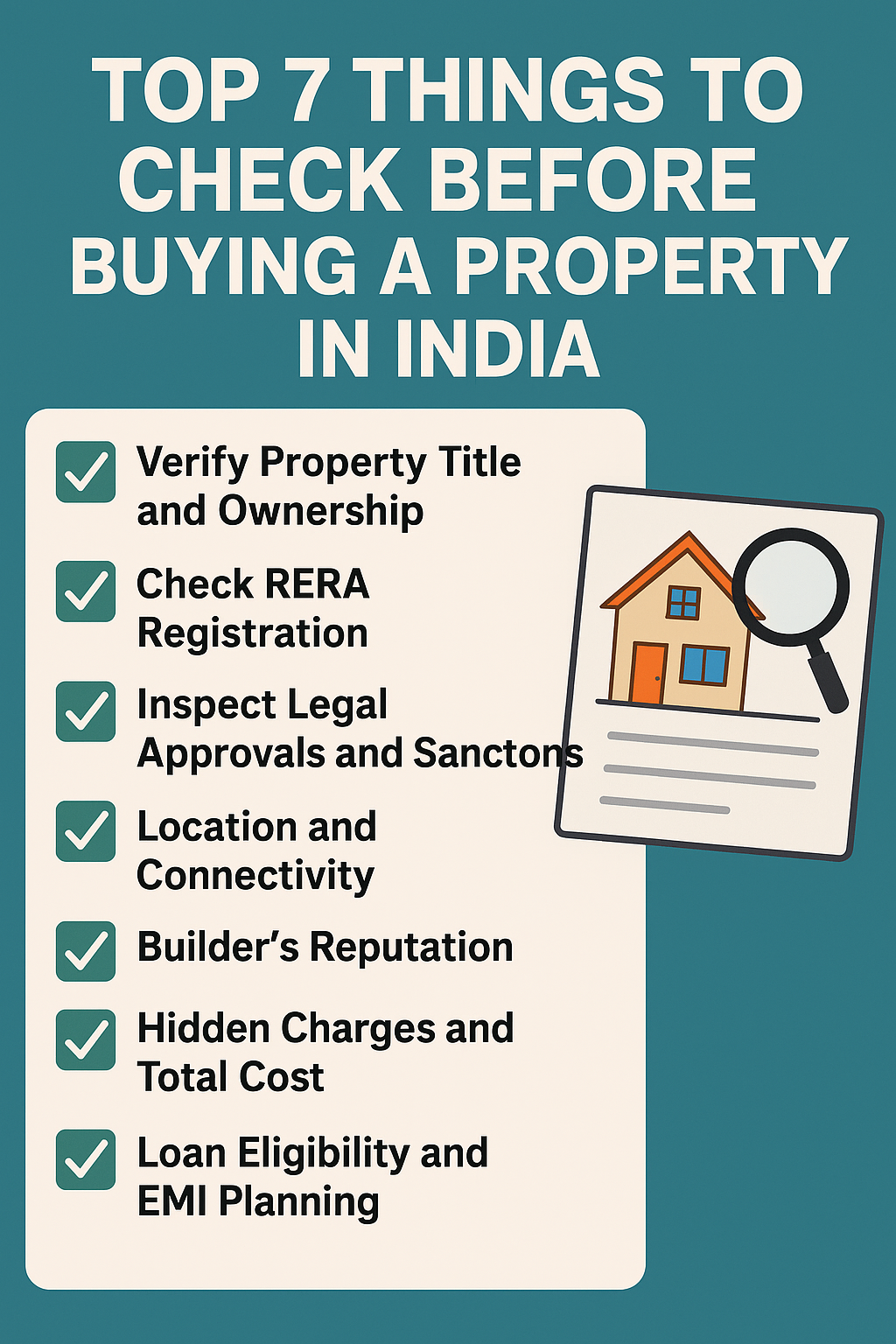
Buying a property in India is one of the biggest financial decisions you’ll ever make. Whether it’s your first home or a long-term investment, being cautious and informed can save you from future hassles. Here’s a property checklist to guide you through the essentials before you finalize any deal. ✅ 1. Verify Property Title and Ownership Before buying any property in India, ensure the title is clear and in the seller’s name. Ask for legal documents like the sale deed, khata certificate, or property tax receipts. If there are multiple owners, all must sign the agreement. ✅ 2. Check RERA Registration Under the Real Estate (Regulation and Development) Act, it’s mandatory for builders to register projects with RERA. Visit your state’s RERA website and verify the project and builder credentials. RERA-approved projects offer better transparency and security. ✅ 3. Inspect Legal Approvals and Sanctions Check whether the builder has secured all necessary approvals from municipal and development authorities—like environmental clearance, land use permissions, and building plan sanctions. Missing approvals can lead to legal disputes or demolition. ✅ 4. Location and Connectivity When buying property in India, location is everything. Ensure the area has good infrastructure, future development potential, access to public transport, schools, hospitals, and basic amenities. Also check for noise levels, pollution, and safety in the neighborhood. ✅ 5. Builder’s Reputation Research the developer’s track record. Look into past project delivery timelines, construction quality, and customer reviews. A reputed builder with RERA compliance reduces your risk significantly. ✅ 6. Hidden Charges and Total Cost Don’t just go by the basic cost per square foot. Ask for a complete cost breakdown including GST, parking, registration fees, maintenance, and club charges. Builders often advertise the base price, while the final cost is much higher. ✅ 7. Loan Eligibility and EMI Planning Get a pre-approved loan quote from your bank to know your eligibility. Compare interest rates, tenure, and EMIs. Choose a loan plan that doesn’t stretch your monthly budget. Also, make sure the property is approved by major banks. Buying a property in India. 🧾 8. Check for Encumbrances Before finalizing any property, always verify that it is free from any legal or financial liabilities. An encumbrance certificate (EC) is a crucial document that shows the history of ownership and whether the property has any loans or disputes attached. You can get this from the sub-registrar’s office. Avoid any property with unresolved legal issues, as it can delay possession and cause financial stress. 🏙️ 9. Understand the Possession Timeline Many homebuyers face frustration when possession dates get delayed. Always ask the builder for a realistic possession timeline and confirm it in writing. Check if there are penalty clauses in case of delay. Also, clarify whether the possession date means basic completion or move-in-ready condition with electricity, water, and occupancy certificate in place. 🛠️ 10. Construction Quality & Amenities Visiting a sample flat or project site is not enough. Examine the materials used, build quality, and finishing. Ask the builder about the structure’s earthquake resistance, plumbing systems, power backup, and lift quality. Also, take a close look at common amenities like the clubhouse, gym, parking area, and children’s play zone—these affect both your comfort and resale value. Buying a property in India. 🔒 11. Security Features (Buying a Property in India) Safety is a major concern, especially in urban areas. Check if the property has CCTV surveillance, security guards, intercom systems, and fire safety protocols. A well-secured building not only keeps your family safe but also adds value to the property. Buying a property in India 🧮 12. Future Development and ROI Before buying property in India, evaluate the area’s future growth. Are there any upcoming metro lines, malls, office parks, or highways? Future infrastructure projects often lead to a sharp rise in property prices and rental yield. Smart investors choose areas with high return-on-investment (ROI) potential based on future plans. Buying a property in India. Buying a property in India 🧑‍⚖️ 17. Hire a Real Estate Lawyer Even if the builder or seller assures you that all documents are in place, it’s wise to consult a qualified real estate lawyer before signing anything. A legal expert can: This one-time cost can save you from future legal troubles or property disputes—especially in cases of resale or inherited property. Buying a property in India 🏘️ 18. Compare Multiple Projects Don’t settle for the first property that looks appealing. Spend time comparing multiple projects in the same area to understand: Visit projects at different times of day to assess noise levels, traffic, and surrounding development. This comparison will give you negotiation power and help you choose better. Buying a property in India 📊 19. Assess Rental Yield (If You’re Investing) If you’re planning to rent out the property, calculate the rental yield — the annual rental income as a percentage of the property cost. For example: If a ₹60 lakh apartment earns ₹18,000/month = ₹2.16 lakh/yearRental Yield = (2.16 ÷ 60) × 100 = 3.6% This helps you evaluate if the property is a good investment. Higher rental yields are usually found in cities with growing IT hubs, colleges, or transit-oriented developments. 📲 20. Use Property Portals and Reviews Before making any final decision, do your homework online. Websites like 99acres, MagicBricks, NoBroker, and Housing.com offer verified listings, builder reviews, locality insights, and price trends. Read user reviews, check builder ratings, and look at historical price movement in the area. Google Maps reviews of societies, project forums, and even Reddit threads can give you candid feedback from actual residents or investors. 🧑‍⚖️ 17. Hire a Real Estate Lawyer Even if the builder or seller assures you that all documents are in place, it’s wise to consult a qualified real estate lawyer before signing anything. A legal expert can: This one-time cost can save you from future legal troubles or property disputes—especially in cases of resale or inherited property. Buying a property in India 🏘️ 18. Compare Multiple Projects Don’t settle for the first

Real Estate

Real Estate Trends in India (2025): What Buyers & Investors Need to Know

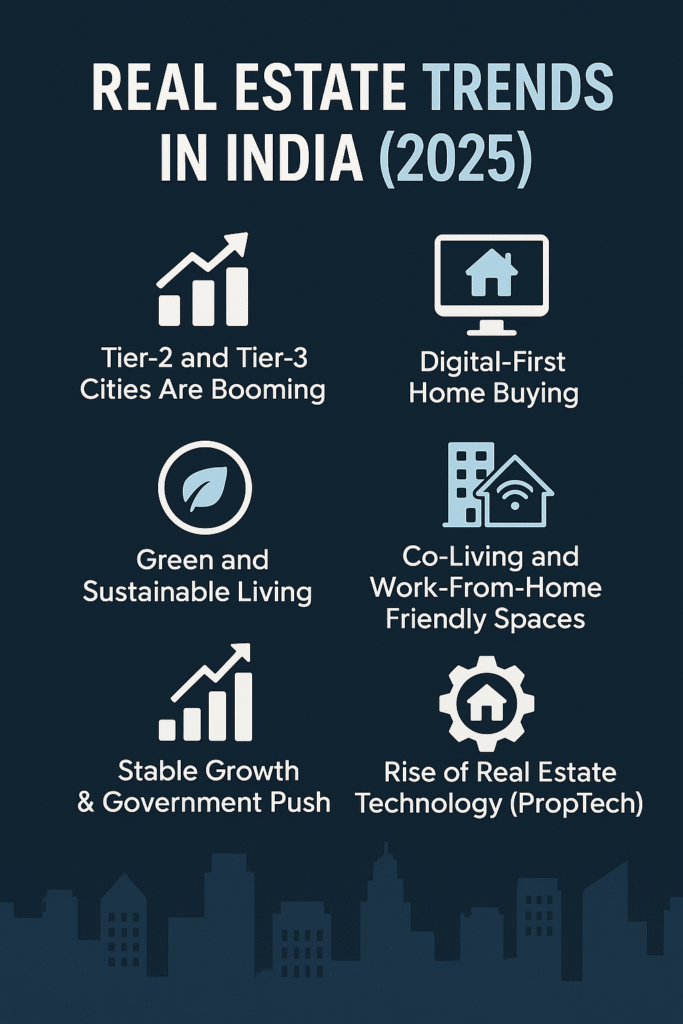
The real estate market in India is undergoing a major transformation in 2025. With changing buyer preferences, policy reforms, and technology-driven solutions, the industry is more dynamic than ever before. Here are the top real estate trends in India is witnessing this year: 1. 📈 Tier-2 and Tier-3 Cities Are Booming Metro cities like Mumbai, Delhi, and Bangalore remain popular, but rising prices and congestion have pushed demand towards Tier-2 and Tier-3 cities like Indore, Lucknow, Coimbatore, and Jaipur. These locations offer affordability, better infrastructure, and growing job opportunities — making them attractive for both buyers and investors. 2. 🖥️ Digital-First Home Buying Post-pandemic habits continue to influence behavior. Virtual site visits, 3D walkthroughs, online documentation, and digital payments are becoming the norm. Tech-savvy millennials prefer a fully digital experience before making a site visit. 3. 🌿 Green and Sustainable Living Sustainability is no longer just a buzzword. Buyers are actively looking for eco-friendly homes — with features like solar panels, rainwater harvesting, and energy-efficient appliances. Builders offering green-certified properties are gaining a clear edge. 4. 🏢 Co-Living and Work-From-Home Friendly Spaces Hybrid work culture is reshaping housing preferences. Homebuyers now look for properties with home offices, better ventilation, and community-driven amenities. Co-living and rental housing also continue to attract young professionals in urban areas. 5. 📊 Stable Growth & Government Push Despite global challenges, India’s real estate sector is seeing steady recovery. Government schemes like PMAY (Pradhan Mantri Awas Yojana) and infrastructure development (smart cities, metro connectivity) continue to boost the sector. 📊 6. Rise of Real Estate trends in India as a Wealth-Building Tool With stock markets fluctuating and fixed deposits offering low returns, more Indians are turning to real estate as a long-term investment strategy. Residential and commercial properties are being viewed not just as assets but as income-generating tools through rentals and value appreciation. NRI investments are also rising, especially in luxury and branded residences in cities like Pune, Hyderabad, and Goa. 🧱 7. Affordable Housing Still in Demand Despite the buzz around luxury and high-end apartments, affordable housing continues to dominate the Indian market. The ₹25–50 lakh price bracket is where most of the demand lies, especially from first-time buyers and salaried individuals. Builders are increasingly focusing on compact 1 and 2 BHK flats in suburban locations, close to metro stations and industrial hubs. 🏗️ 8. Infrastructure-Driven Growth Corridors Areas that are seeing massive infrastructure upgrades — like new expressways, metro lines, and airports — are emerging as investment hotspots. For instance, the Dwarka Expressway in Gurgaon, Peripheral Ring Road in Bangalore, and Mumbai Trans Harbour Link (MTHL) are pushing up property values in nearby regions. Smart investors are closely following these corridors to spot the next big opportunity. 🧑‍💼 9. Commercial Real Estate: A Quiet Comeback While work-from-home is still common, commercial real estate trends in India is making a strong comeback in 2025. Co-working spaces, flex offices, and small business hubs are in high demand. Cities like Pune, Hyderabad, and Ahmedabad are seeing steady absorption of commercial properties by startups, IT firms, and manufacturing companies. 📉 10. Regulatory Transparency and RERA’s Role The implementation of RERA (Real Estate Regulatory Authority) has increased transparency and accountability across the sector. Homebuyers are more confident now due to improved project delivery timelines and legal protections. This shift has cleaned up a large part of the unorganized market and created a safer investment environment. Real estate trends in India. 📝 Conclusion: A Market in Transition To sum up, the real estate trends in India is experiencing reflect a maturing, digitally-enabled, and investor-friendly market. Whether you’re looking to buy a home, invest in rental property, or explore commercial opportunities, 2025 offers diverse options. Keep an eye on emerging cities, stay informed on policy changes, and always do your due diligence. 🏗️ 11. Rise of Real Estate Technology (PropTech) The adoption of PropTech (Property Technology) is revolutionizing how people search, buy, sell, and invest in real estate. AI-driven platforms now offer personalized property recommendations, price trend analysis, and fraud detection. Blockchain is being explored for secure property records and smoother transactions. Builders are also using construction tech for faster and more cost-efficient project completion. This tech-forward shift makes the industry more transparent, accessible, and buyer-friendly. Real estate trends in India. 🧓 12. Senior Living and Wellness Communities India’s ageing population and growing awareness around health and lifestyle are fueling demand for senior living and wellness-focused communities. These projects often include medical support, green spaces, wellness centers, and gated security. They’re gaining traction in cities like Pune, Coimbatore, and Dehradun. Developers catering to this niche are seeing long-term potential and strong investor interest. Real estate trends in India. 🌐 Final Word The real estate trends in India is seeing in 2025 show a strong alignment with global shifts—tech adoption, sustainable building, and lifestyle-driven choices. Whether you’re an end-user or an investor, understanding these trends helps you stay ahead of the curve in an increasingly competitive market. 🧠 13. Smart Homes Are Becoming the Norm With the increasing integration of the Internet of Things (IoT), smart homes are no longer a luxury — they’re quickly becoming a standard expectation. Features like smart lighting, voice-activated assistants, automated security systems, and energy monitoring tools are being included in mid-range and premium homes alike. Buyers are prioritizing comfort, security, and energy efficiency when choosing properties. Builders offering smart-ready homes are seeing a significant increase in interest, especially from younger homebuyers and tech-savvy professionals. Real estate trends in India. 👨‍👩‍👧 14. Lifestyle-Driven Housing Choices Today’s buyers are not just looking for a house; they’re looking for a lifestyle. Gated communities with amenities like co-working spaces, fitness centers, cafes, and community events are in high demand. There’s a growing preference for self-sustained townships or mixed-use developments where residents can live, work, and relax—all within one ecosystem. This shift reflects the post-pandemic mindset where convenience, safety, and quality of life are top priorities. 🔚 Wrapping Up From smart tech to sustainability and lifestyle integration, the real

Real Estate

Real Estate in 2025 is full of exciting opportunities.

The real estate market is always evolving, and 2025 is no exception. With shifting economic conditions, changing consumer preferences, and advancements in technology, buyers, sellers, and investors must stay informed to make smart decisions. Whether you’re looking to buy your first home, invest in rental properties, or sell a house for top dollar, understanding today’s market is key. 📈 2025 Real Estate Trends 1. Rising Interest in Secondary Cities Major metros are still popular, but rising costs are pushing people toward smaller cities with strong job markets, good infrastructure, and lower living costs. Places like Raleigh, Boise, and Tampa are gaining traction among millennials and remote workers. 2. Technology Is Changing the Game Virtual tours, AI-powered property recommendations, and blockchain for secure transactions are now standard tools in the real estate toolkit. Tech-savvy buyers expect a seamless, digital-first experience. 3. Eco-Friendly Homes Are in Demand Sustainability isn’t a luxury anymore—it’s a must-have. Energy-efficient appliances, solar panels, and green certifications (like LEED) can significantly increase a property’s value and appeal. 4. Short-Term Rentals Remain Strong Despite regulatory pressures in some cities, short-term rental platforms like Airbnb continue to be profitable for investors, especially in tourist-friendly areas and near universities or medical centers. 🏠 Tips for Buyers 💼 Tips for Sellers 💰 Tips for Investors 📈 Real Estate is Still a Strong Long-Term Investment Despite short-term fluctuations, real estate has historically proven to be a reliable long-term asset. Buying now could mean capitalizing on future appreciation — especially in high-growth regions or up-and-coming neighborhoods. 🏘️ Tips for Smart Home Buying in 2025 🏡 Real Estate Insights: Why Now Might Be the Perfect Time to Buy a Home In today’s fast-changing housing market, one question is on everyone’s mind: Is now a good time to buy a home? While timing the market perfectly is impossible, current trends suggest that buyers who act strategically could benefit in big ways. 🔍 Market Cooling Offers More Opportunity After years of intense competition, many housing markets are experiencing a slowdown. Homes are sitting on the market longer, and bidding wars are less frequent. This gives buyers more leverage to negotiate price, contingencies, and repairs. Sellers are also more willing to offer concessions such as covering closing costs or making upgrades to close the deal. 📍 Final Thoughts Real estate remains one of the most reliable ways to build long-term wealth, but it requires research, timing, and smart strategy. Whether you’re buying your dream home, flipping a fixer-upper, or investing in rental properties, staying educated and working with trusted professionals is essential in 2025.

Scroll to Top